SightScore™ Genetic Risk Test
The Future of Your Vision — and Your Family's. Analyzes 7 million+ genetic variants to identify genetic risk of developing disease and disease progression.
One-time test · Cash pay
Who Should Get Tested?
SightScore is suitable for a wide range of patients
Especially Beneficial For:
People Diagnosed with Glaucoma
Understand your progression risk to guide treatment and monitoring decisions
Glaucoma Suspects & Ocular Hypertensives
Identify your risk of conversion to glaucoma and inform monitoring frequency
Family Members
Identify which first-degree relatives have inherited a high genetic risk and should be checked
Adults Without Glaucoma
Understand your personal genetic risk and when to begin screening
Important Considerations:
Validated Across Ancestries
Validated with samples of European, African, South Asian, Hispanic, and East Asian ancestries
One Piece of the Puzzle
SightScore combines with clinical factors for comprehensive risk assessment
Not Diagnostic
SightScore tells you about your future risk. It is not your destiny. It does not diagnose glaucoma.
Provider-Interpreted
Results are delivered to your eye health professional, who will discuss them with you
Adult-Onset POAG Only
This test is for adult-onset Primary Open Angle Glaucoma. It is not intended for closed-angle glaucoma or individuals under 18.
How It Works
Simple process from order to results
Order
Order your test online — we'll coordinate the provider order with your doctor
Receive Kit
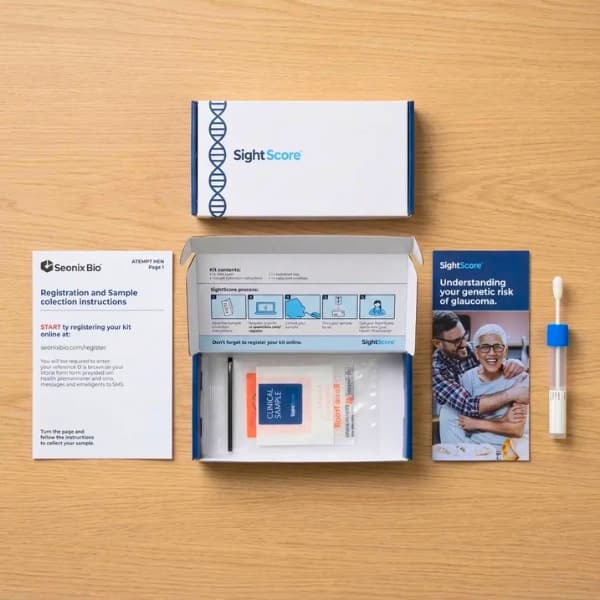
Collection kit arrives at your home
Collect
Simple saliva collection takes less than 1 minute
Mail Back
Use prepaid envelope to return sample
Lab Analysis
CLIA-certified lab extracts and genotypes your DNA
Scoring
Algorithm calculates your SightScore
Report
Results sent to your eye health professional
Discuss
Review results with your doctor within 2-4 weeks
Typical Timeline: 2-4 weeks from sample receipt to results
We'll notify you at each step so you always know where your test stands
What You'll Learn
Comprehensive insights from your genetic profile
Your Risk Percentile
SightScore positions you on a genetic risk spectrum relative to others in the community with similar ancestry, so you and your doctor can see where you stand.
Example Risk Levels:
- Lowest (0-20th percentile)
- Intermediate (20th-70th percentile)
- Higher (70th-90th percentile)
- Highest (90th-100th percentile)
Risk of Developing Disease & Progression
SightScore analyzes 7 million+ genetic variants to identify your genetic risk of developing glaucoma and disease progression.
- Genetic risk of developing glaucoma
- Risk of progressive vision loss
- Risk of needing treatment or treatment escalation
Clinical Management Considerations
Depending on your medical history and eye examination, your eye health professional may use SightScore to consider:
- When you should first be checked for glaucoma
- How often you should be checked for glaucoma
- Whether to refer you to a more specialized healthcare practitioner for monitoring
- How to manage your care if you have glaucoma, including some treatment decisions
Family Insights
A family history is not the same as a person's individual genetic risk. SightScore uses your own DNA to assess your individual risk.
- Whether your close blood relatives should be checked for glaucoma
- Identify which first-degree relatives have inherited a high genetic risk
- Be proactive about follow-up appointments and lifestyle changes
Scientific Foundation
- Based on world-leading research published in Nature Genetics and JAMA Ophthalmology
- Validated against independent cohorts from the UK, US, and Australia
- Validated with European, African, South Asian, Hispanic, and East Asian ancestries
- CLIA-certified laboratory processing
Privacy & Security
- HIPAA compliant data handling
- Samples destroyed after analysis
- No data sharing without consent
- Secure encrypted data storage
Billing
SightScore is a "cash pay" test and is not eligible for insurance claims.
Scope
SightScore is specifically for adult-onset Primary Open Angle Glaucoma. It is not intended for those with closed-angle glaucoma or individuals under 18.
Regulatory Disclaimer
The FDA does not require this test to go through premarket FDA review. SightScore is performed by a laboratory certified under the Clinical Laboratory Improvement Amendments Act of 1988 (CLIA-88) as qualified to perform high complexity clinical testing.
References
- Craig, J et al., 2020. "Multitrait Analysis of Glaucoma Identifies New Risk Loci and Enables Polygenic Prediction of Disease Susceptibility and Progression." Nature Genetics 52(2):160–66.
- Siggs OM et al., 2022. "Association of High Polygenic Risk With Visual Field Worsening Despite Treatment in Early Primary Open-Angle Glaucoma." JAMA Ophthalmol. 2023;141(1):73–77.
- Marshall et al., 2023. "High Polygenic Risk Is Associated with Earlier Initiation and Escalation of Treatment in Early Primary Open-Angle Glaucoma." Ophthalmology 130(8):830–836.
- Marshall et al., 2022. "High Polygenic Risk Is Associated with Earlier Trabeculectomy in Patients with Primary Open-Angle Glaucoma." Ophthalmology Glaucoma, 2023 Jan-Feb;6(1):54–57.
The Future of Your Vision — and Your Family's
Understand your genetic risk with SightScore and empower your doctor to make more informed decisions about your care.